

Specialist Disability Accommodation (SDA) housing investment represents a unique opportunity in Australia’s property market, blending social impact with financial returns. As part of the National Disability Insurance Scheme (NDIS), SDA targets housing for individuals with extreme functional impairments or very high support needs. This guide explores what SDA housing investment entails, the best investment options, average returns, how to evaluate providers, as well as the tax benefits, thereby providing actionable insights for investors aiming for stable, government backed income streams.
What is SDA Housing Investment?
SDA housing investment involves funding or purchasing purpose-built properties designed to meet the strict NDIS SDA Design Standards. These homes feature accessibility elements like widened doorways, hoists, ramps, and smart technology to enable independent living and the safe delivery of supports for eligible NDIS participants. Unlike traditional rentals, SDA funding comes directly from participants’ NDIS plans, covering accommodation costs rather than personal care services.
Under the NDIS, the government allocates significant funding (over $700 million annually) to SDA, shifting from block grants to participant driven choices. Investors act as SDA providers, enrolling dwellings with the National Disability Insurance Agency (NDIA) to receive payments. This creates a reliable rental model encompassing SDA contributions plus participants’ rent from pensions and Commonwealth Rent Assistance (CRA). Properties must comply with SDA rules, including adhering to pricing limits and vacancy reporting, but the NDIA does not own or build the homes. That falls to specialist SDA builders, like All Ability.
Demand is outstriping supply, with projections showing robust growth over coming years. Around 4.3 million Australians have disabilities, and the NDIS supports over 610,000 participants, many needing SDA. Investors benefit from higher than market rents while addressing a critical social need, making it a form of social infrastructure investment. Conversely, risks include market saturation and regulatory changes, so due diligence is essential.
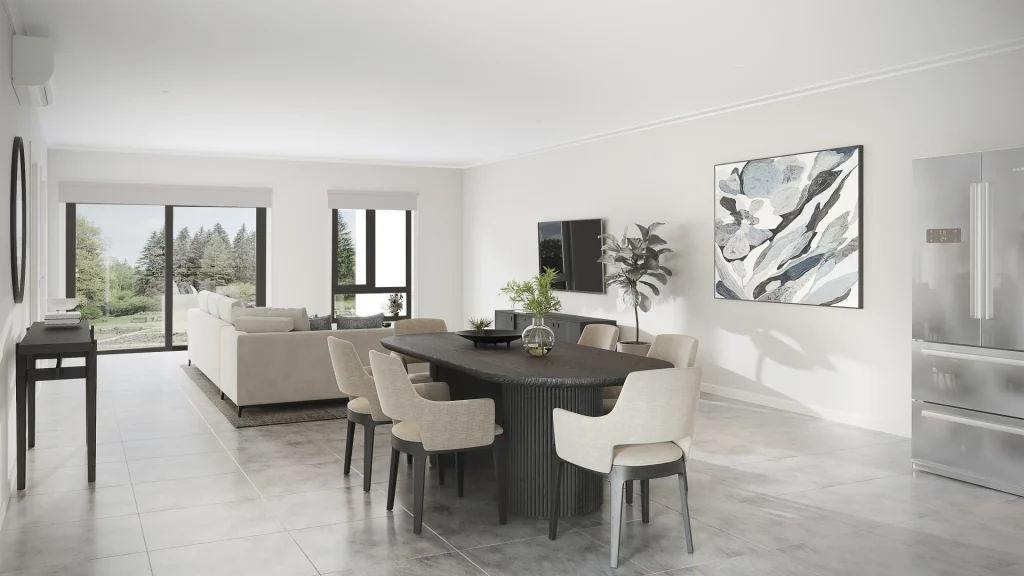
What are the Best SDA Housing Investment Options Available in Australia?
The best SDA options balance high yields, location, and compliance. Popular dwelling types under NDIS categories – High Physical Support (HPS), Fully Accessible (FA), Robust (RB), and Improved Liveability (IL) – cater to varying impairment levels. Here’s a breakdown:
- Dual occupancy or townhouses/units are ideal for beginners. With estimated weekly returns of $895 to $1,225 in regional areas of NSW (after an initial purchase price of $1.18M) these offer low entry cost, are SMSF-eligible, and quick to enrol.
- Cutom and purpose built homes offer turnkey solutions and are mostly 3 – 4 bedroom houses meeting strict design standards, often including overnight accommodation provisions for carers. These offer multiple tenancies and are currently in high demand in undersupplied regions.
- When considering new versus established options, keep in mind that new builds qualify for higher SDA payments due to modern features, while established homes need retrofits. Consider focusing on 2025 hotspots like metro areas of Queensland and NSW where there is an undersupply of SDA accommodation, as well as regional areas of the NT, WA and NSW where supply is below the national SDA average.
Look to prioritise homes with onsite overnight accommodation (OOA) and included safety features (like fire sprinklers) as these are considered more Fully Accessible homes that would qualify for maximum funding . Avoid oversaturated urban areas that have been blacklisted by lenders. We see that rental yields tend to improve through different SDA tenant mixes, often when the build times are shortened and the homes include energy efficient technologies. These homes are are more attractive to participants and providers alike.
Active Alerts
What is the Average Return on Investment for SDA Housing Projects?
Average ROI for SDA projects can range between 8 – 12% net yield (approx), outperforming standard rentals which often return a gross yield ranging between 4 – 6%. Some NDIS/SDA properties may secure 12%+ returns, driven largely by SDA payments (covering build costs) plus Commonwealth Rent Assistance (CRA) and participant contributions. Take Queensland as an example, these investments can yield high, predominantly due to high local demand, with ROI encompassing SDA funding, rent assistance, and pensions.
Additional factors that can influence your returns:
- New pricing arrangements came into effect in 2025. These NDIS limits ensure sustainability and on average increased SDA per participant by 15% yearly.
- Locations and saturation levels. Saturation areas are currently low in many regional areas but it’s worth knowing that some areas have a high concentration of SDA properties. In some cases this has led to over supply with banks tightening lending in these locations throughout 2025.
- Be sure to monitor your expenses. While these can be readily offset by yields, factoring in the higher cost of property management fees is a must. These are higher than traditional property investments.
How Do I Evaluate SDA Housing Providers for Investment Reliability?
Assessing provider reliability is essential to minimising risks like non-compliance, delays, or suboptimal tenancy outcomes. Focus on providers with proven expertise in NDIS SDA Design Standards and ideally, a participant-first model, and those prioritising end to end services ensuring compliance, quality, and maximising investor returns. Here’s our structured evaluation framework, emphasising key services for reliability.
Track Record & Experience: Look for providers with deep NDIS/SDA involvement from inception, backed by years of experience and expertise. This will be evident in the number of projects completed, as well as the depth of talent in the management team. Verify a history of direct partnerships with top tier SIL/SDA providers and high participant satisfaction through consistent communication and quality outcomes.
Participant-First Approach & Compliance: Prioritise those pioneering a participant first model (a model All Ability is pioneering), while delivering quality homes that exceed SDA specifications. Confirm NDIA enrolment success, full certification, and low vacancy rates via public data.
Comprehensive Services & Risk Mitigation: Seek turnkey solutions covering site selection, custom designs fit for incoming participants, due diligence, advanced construction, project management, certification, and post-handover support. Offering value added services, such as assistance with lending, insurance, and surveying is an added bonus.
Innovation & Efficiency: Evaluate for cutting edge techniques that can reduce build times and costs while enhancing durability. Firms with a national reach with proven projects in many state signals scalability and capability.
Transparency & Investor Support: Ask for full financial projections, yield calculations, and ongoing client assistance to help you make an informed decision. Check references to help in avoiding high-pressure sales tactics.
What are the things to look out for? Lack of SDA specialisation, generic builds risking compliance failures, or absent risk mitigators. Any one of these could lead to a less than optimal outcome.
Partnering with leaders offering NDIS Participant led housing programs offers a low risk, potentially high return paths. Always include other members of your financial team – your accountant and/or your financial advisor – to help you understand the projects implications and projections.
What Tax Benefits Apply to SDA Housing Investments in Australia?
SDA housing investments offer tax advantages that mirror and often surpass those of traditional property investments, primarily due to the elevated construction costs of accessibility features like the previously mentioned hoists, ramps, widened doorways, and reinforced structures. While both investment types leverage negative gearing, capital works (Division 40 and Division 43) depreciation, and ongoing deductions, SDA properties amplify these benefits through higher qualifying expenses, often leading to superior cash flow and long-term returns. Here’s a detailed comparison and breakdown.
Negative Gearing: Similar Foundation, Enhanced SDA Impact
Both traditional rentals (standard houses or apartments) and SDA properties allow negative gearing, where rental income minus deductible expenses (interest, rates, insurance, repairs) creates a loss offset against other taxable income. For high earners at 45–49% marginal rates, this reduces tax liability significantly.
- Traditional Property: Typical deductions cover basic costs and while negative gearing works well, gross yields are an often a modest 4 to 6%.
- SDA Advantage: Higher SDA-funded rents (8 to 12% yields) paired with substantial upfront costs ($1M to $2M builds) generate larger losses initially thereby accelerating tax savings. Post gearing, SDA’s stable NDIS income would normally sustain ongoing profitability.
Tax Depreciation: SDA’s Standout Edge
Depreciation claims the decline in asset value over time, be it the building materials, fixtures and fittings and is a core benefit often underutilised by 80% of investors. Quantity surveyor reports maximise these deductions for you.
- Division 40 (Plant & Equipment): Covers short life span items like appliances, blinds, and carpets . Traditional properties claim approximately $5,000 to $10,000 per year, while SDA properties add disability technologies (hoists, smart systems and the like), often boosting deductions anywhere up to $50,000 annually due to these premium fittings.
- Division 43 (Capital Works): Covers building fabric (ie the walls and roof) over a much longer 40 year period at 2.5% each year. A $1M traditional build deducts approximately $25,000 per year while SDA’s extra modifications (lifts, fire supression systems) can push yields even higher, often dwarfing traditional investment claims.
Additional Deductions & Incentives
Both types of investment can claim property management fees (these are often higher under SDA), maintenance, and tenant gifts. SDA excels with:
- Instant Asset Write-Offs: Claiming eligible property modifications under the thresholds.
- Higher Basis for Claims: Initial construction premiums directly tied to SDA standards.
Is SDA Housing Investment Right for You?
SDA housing investment can offers 10+% returns, tax efficiencies, and social good amid rising demand. On the flip side, initial capital investment will likely be higher. Start with your due diligence – analyse locations, providers like All Ability, and consult financial advisors. While risks exist (regulation, certification, etc), structured approaches yield success.
If you would like to further explore the opportunities available for investing in NDIS/SDA projects, either as an investor, or an entity with capital, we would welcome the opportunity to present these to you. Jump over to our contact page to schedule an in person discussion.
The information provided on and made available through this website does not constitute financial product advice. The information is of a general nature only and does not take into account your individual objectives, financial situation or needs. It should not be used, relied upon, or treated as a substitute for specific professional advice.
We recommend that you obtain your own independent professional advice before making any decision in relation to your particular requirements or circumstances. Property Professionals of Australia do not warrant the accuracy, completeness or currency of the information provided on and made available through this website. Past performance of any product discussed on this website is not indicative of future performance.